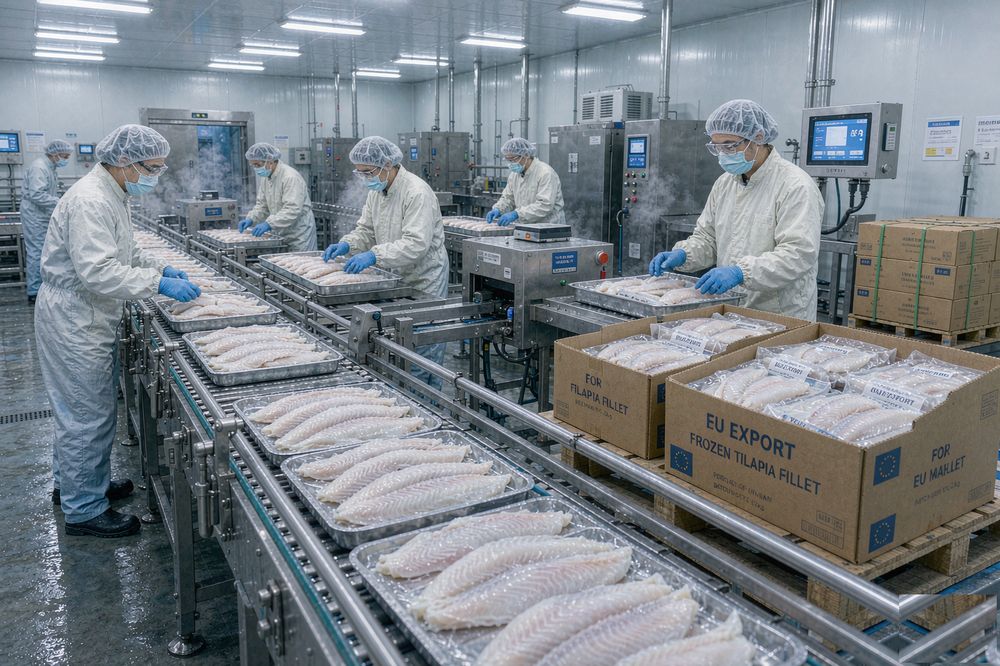
EU Market Entry & Eurofish Trends: Frozen Tilapia Sourcing in 2026
September 7, 2026 — Europe remains one of the world’s most demanding whitefish markets. With domestic wild catches constrained and consumer demand for affordable, mild-flavoured fillets holding firm, the European Union is deepening its reliance on imported frozen tilapia and pangasius. For B2B seafood buyers, traders, and foodservice chains, the second half of 2026 presents both a sourcing opportunity and a compliance test. This report examines the latest Eurofish market trends, China’s tilapia export dynamics, Vietnam’s pangasius momentum, and what EU-bound importers should look for in a frozen seafood supplier.
The European Union is structurally short on whitefish. Local production of tilapia is negligible, and traditional species such as cod and Alaska pollock face tightening quotas and elevated prices. According to industry analysts, the European tilapia market is forecast to reach US$158 million by 2035 , expanding at a compound annual growth rate of roughly 2.5% . While the growth rate appears modest, the absolute import volume is significant because it is entirely import-driven.
The Netherlands has consolidated its role as the EU’s primary seafood trade hub, handling nearly 59% of intra-European tilapia flows. Dutch importers source bulk frozen fillets and whole fish, then re-export to Germany, France, Belgium, Spain, and Poland. This hub-and-spoke model means that access to the EU market often begins at Rotterdam — and success there depends on consistency, traceability, and certifiable food safety.
NEGUPGROUP SEAFOOD | WhatsApp +86 13360658417 | [email protected] | www.negupgroup.com
China remains the dominant origin for frozen tilapia. In April 2026, Chinese customs data showed total tilapia exports of 57,010.6 tonnes , valued at US$105 million , for an average unit price of US$1.84/kg . Frozen fillets — the product form most relevant to European buyers — accounted for 21,569 tonnes worth US$52.16 million , averaging US$2.42/kg .
Europe’s preference is clear: Germany, the United Kingdom, France, and Belgium are the leading EU/UK destinations for Chinese frozen tilapia fillets. In April 2026 alone, Germany imported 1,268.9 tonnes , the UK 1,107.6 tonnes , France 777 tonnes , and Belgium 734 tonnes . These figures underscore Europe’s reliance on premium fillet cuts rather than the bulk whole-fish trade that dominates West Africa and Latin America.
Yet Chinese supply is not without risk. China’s 2026 tilapia production is forecast to decline slightly to approximately 1.82 million tonnes (live-weight equivalent), down from 1.94 million tonnes in 2025, while export volume is expected to rise to 1.15 million tonnes . The mismatch — lower domestic production plus higher exports — is tightening raw material availability and could support a price recovery in the fourth quarter.
NEGUPGROUP SEAFOOD | WhatsApp +86 13360658417 | [email protected] | www.negupgroup.com
While tilapia dominates China’s whitefish exports, Vietnam’s pangasius is increasingly competing in the same shelf space. The FAO has identified pangasius as a viable alternative to higher-priced wild whitefish, particularly in the European Union. In the first half of 2026, Vietnam’s pangasius exports to the EU reached approximately US$91 million , up 3% year-on-year, with June alone generating around US$20 million (up 56% year-on-year).
Global pangasius production is expected to exceed 4 million tonnes in 2026, with Vietnam accounting for the largest share. For European buyers, the appeal is straightforward: stable aquaculture supply, competitive pricing, and a fillet format that fits retail and foodservice applications. NEGUPGROUP’s frozen pangasius fillet line is positioned precisely for this segment.
NEGUPGROUP SEAFOOD | WhatsApp +86 13360658417 | [email protected] | www.negupgroup.com
Market Snapshot: EU Imports of Chinese Frozen Tilapia — April 2026
Source: China Customs / Seafood Media Group (April 2026 trade data). Figures reflect China’s direct exports to each market and exclude intra-EU re-exports via the Netherlands.
Entering the EU seafood market is not only about price and volume. European buyers — especially retailers, foodservice chains, and broadline distributors — require documented compliance at every stage. The baseline expectations include HACCP , BRCGS Food Safety , and IFS Food . Many retail programmes additionally require ASC or BAP aquaculture certification for farmed species, as well as transparent labelling and traceability dossiers.
EU border controls for products of animal origin are strict. Consignments must be pre-notified through the TRACES system, cleared at a Border Control Post, and supported by an official health certificate. Residue testing, additive declarations, and accurate net-weight/glaze labelling are scrutinised. Any failure can result in rejection, RASFF alerts, and buyer delisting.
For importers, this means supplier qualification should go deeper than sample tasting. It should include factory audits, HACCP plan review, cold-chain validation, lot-traceability testing, and verification that packaging, glaze percentages, and carton markings match buyer specifications.
NEGUPGROUP SEAFOOD | WhatsApp +86 13360658417 | [email protected] | www.negupgroup.com
NEGUPGROUP SEAFOOD supplies frozen tilapia and pangasius products aligned with European market specifications. Our standard product range includes:
Frozen Tilapia Whole Fish: 300-500g, 500-800g, 800g+ — IQF or block frozen, 10kg/carton
Frozen Tilapia Fillet: 3-5oz and 5-7oz, skin-on or skinless, IQF or block frozen, 10kg/carton
Frozen Pangasius Fillet: 3-5oz well-trimmed, IQF or block frozen, 10kg/carton
All products are produced under HACCP-based quality management, with carton lot coding for traceability and recall readiness. We support custom glazing, packing, and labelling requirements for retail and foodservice programmes. EU-bound shipments are dispatched in reefer containers with continuous temperature monitoring and full documentation for Border Control Post clearance.
NEGUPGROUP SEAFOOD | WhatsApp +86 13360658417 | [email protected] | www.negupgroup.com
Download our companion market brief for a concise summary of EU import channels, pricing trends, certification requirements, and NEGUPGROUP product specifications.
NEGUPGROUP SEAFOOD | WhatsApp +86 13360658417 | [email protected] | www.negupgroup.com
Includes: China/EU trade data, certification checklist, product specs, cold-chain guidance, and contact details.
First, the EU whitefish market is becoming a two-origin story: China supplies scale and tilapia variety; Vietnam supplies pangasius as an affordable cod alternative. Buyers who qualify both origins can balance price, supply security, and product mix.
Second, the Netherlands is the operational heart of EU tilapia distribution. Landing product in Rotterdam and working with a re-exporter remains one of the most efficient routes into Germany, France, Belgium, and beyond.
Third, certification and traceability are non-negotiable. HACCP, BRCGS/IFS, and ASC/BAP where required, plus complete TRACES-ready documentation, are the minimum threshold for doing business with mainstream EU buyers.
Fourth, with Chinese tilapia production forecast to decline while exports rise, Q4 2026 may see firmer raw-material prices. Locking in supply now with qualified exporters reduces both price and allocation risk.
If you are sourcing frozen tilapia or pangasius for the European market, NEGUPGROUP SEAFOOD can support your programme with HACCP-compliant products, flexible specifications, and full export documentation.
Request Quotation — Ask for Samples — Check Product Specifications — Contact NEGUPGROUP Seafood Team
WhatsApp: +86 13360658417 | Email: [email protected] | Web: www.negupgroup.com
Talk to the NEGUP trading desk — quotes within 24 hours.
Contact NEGUP Foods